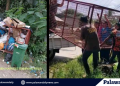






In a city with a population of 307,079, some 65.91% or roughly 202,300 individuals work either in government offices or private companies, commercial establishments, or in the informal economy.
If two thirds of these 202,300 workers or 134,866 individuals buy their food for their breakfast, snacks and/or lunch from nearby canteens, carenderia or fast food joints, then there’s an estimated 1,213,794 pieces of plastic labo disposed daily from Monday to Friday, either in workplace’s trash bins, mobile waste bins in roadside, or simply thrown away in vacant lots, drainage canals or in public places.
The figure is based on the estimate given by workers and employees themselves who said that they got at least 8 to 9 pieces of plastic labo as food packaging and extra packaging. Therefore, 134,866 x3 pieces of plastic labo x 3 meals (breakfast, lunch,snacks), is equivalent to 1,213,794 (1.2 million) pieces.
In an office with 15 employees, if food is ordered in a carenderia, their soiled plastic labo in a week or an estimated 675 pieces can fill more than two large sacks (the 50kg rice sack) if properly compacted.
It is assumed here that one third of the workers or the 67,434 individuals chose to bring reusable food wares for their food.
Plastic labo is a type of translucent or clear plastic bag, a thin plastic film and a single-use plastic. The bag is typically made from Low-Density Polyethylene (LDPE) often used for packaging fresh food, produce, and small groceries.
In a year with an average of 260 to 261 working days, it is assumed that we throw away some 316,800,234 (316 million) pieces of plastic labo, or if put in a large sack can reach 1,056,000 (more than 1 million) large sacks if properly compacted. In a span of 10 years, plastic labo from workers alone reached 3,168,002,340 (3.1 billion) pieces, or 10,560,007 pieces of large sacks filled with filthy soiled plastic.
This plastic labo came from workers and employees in their offices and workplaces alone, excluding those individuals who are in the comfort of their homes, but chose to buy food from nearby carenderia.
Why am I presenting this assumption? Because the plastic labo that we bring to our workplaces became soiled plastic films few hours or few minutes after we bought the food, and after that, these plastic labo become residual wastes, meaning- these are non-recyclable and non-compostable materials that cannot be diverted from the waste streams.
Soiled plastics including plastic labo are thin, contaminated plastic sheets, primarily from packaging like stretch wrap with dirt/food. These are dirty with food wastes, making them a significant source of environmental pollution as they break down into microplastics.
These soiled and stained plastic as food packaging attract rats, vermin and flies infestation, because they retain color and food particles/ food debris.
One of the impacts of the presence of these soiled plastic labo is soil degradation. Plastics change the physical and chemical properties of the soil, such as bulk density, water retention and pH levels. This harms soil natural organisms such as earthworms and microbes which are considered as vital for soil health and fertility. This results in reducing plant growth and crop yields. Another impact of soiled plastics to the natural environment is the toxic leaching. This happens because plastic contains harmful chemical additives such as Bisphenol A (BPA), phthalates, flame retardants, and heavy metals that can leach into the surrounding soil and water. These toxins are harmful to both humans and wildlife.
The persistence and widespread nature of soiled plastics make them a serious threat to our existence that definitely affects environmental quality, biodiversity, and human health.
Let us not wait for a city ordinance that will ban the use of plastic labo as packaging for our cooked food, or wait for government enforcers to issue citation tickets because we violate laws, but rather let us just act accordingly simply because all of us are stewards of God’s creation.
The start of the year 2026, is a perfect occasion for us to simply make some change the way we prepare or buy our food. Let us bring reusable food wares in canteen and carenderia, a simple way to get rid of plastic labo.


ADVERTISEMENT