


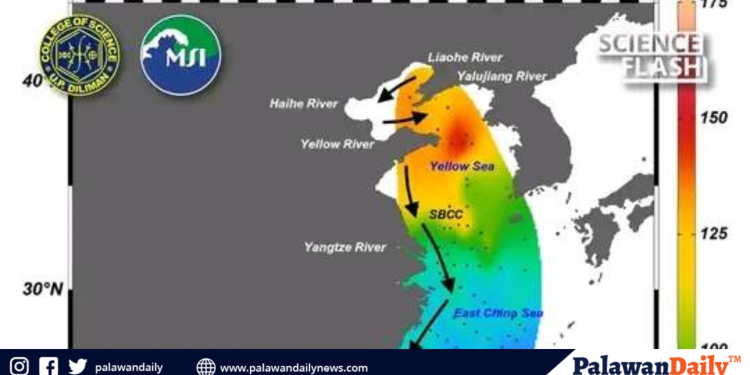

The University of the Philippines-Marine Science Institute (UP-MSI) said that seawater analysis in the West Philippines Sea (WPS) showed presence of iodine-129 an indicator of nuclear activities.
“As a fission product, iodine-129 is often used as an indicator of nuclear activities in an area. But despite the Philippines’ lack of active nuclear power plants or nuclear weapons, seawater analysis shows that the West Philippine Sea has higher levels of iodine-129 than anywhere else in the country. The likely explanation? The radioactive isotope came from further up north,” the UP-MSI said.
Fission products are the lighter atomic nuclei that form when a heavy atomic nucleus (like Uranium) splits during nuclear fission, releasing energy and neutrons; these resulting fragments are often highly radioactive and unstable, decaying further to release more energy and particles.
The UP-MSI said that a team of experts from Department of Science and Technology (DOST) Philippine Nuclear Research Institute, Geological Oceanography Laboratory-UP MSI, and Tokyo University tracked the origins of iodine-129 to the Yellow Sea.
The Yellow Sea is a shallow, semi-enclosed sea of the Western Pacific, located between mainland China and the Korean Peninsula, named for the yellow silt carried by rivers like the Yellow River (Huang He) that color its waters.
The UP-MSI further said that after analyzing 119 samples from various points in the archipelago, they found that the WPS has 1.5x to 1.7x more iodine-129 than other sampling areas.
“The study hypothesizes that these levels are connected to the high iodine-129 levels in the Yellow Sea. This is supported by recent Chinese studies, Liu et al. 2025 and Wang et al. 2024, which trace the isotope’s presence to decades-old nuclear weapons tests and European nuclear fuel reprocessing facilities that seeped iodine-129 into the soils and rivers of northeastern China. It is possible that the iodine-129 in the Yellow Sea was then brought to Philippine waters through the Yellow Sea Coastal Current and the Chinese Coastal Current. Further oceanographic modeling is needed to confirm,” the UP MSI explained.
Though iodine-129 is radioactive, its current levels in the WPS pose no harm to human health or the environment. The study emphasizes that efforts to monitor and regulate radioactive materials should be improved, especially when they cross national boundaries.