


Off Palawan’s western frontier, confrontation has become a familiar sight. Philippine ships in white paint glide toward larger gray counterparts, their presence alone signaling tension. Columns of water rise and fall. Voices over marine radios carry urgency and restraint in equal measure. Fishing boats linger at the margins of uncertainty. The scenes are captured in high resolution and shared within minutes. But what spreads with greater speed and deeper consequence is the framing of those encounters, the storyline that outlives the spray.
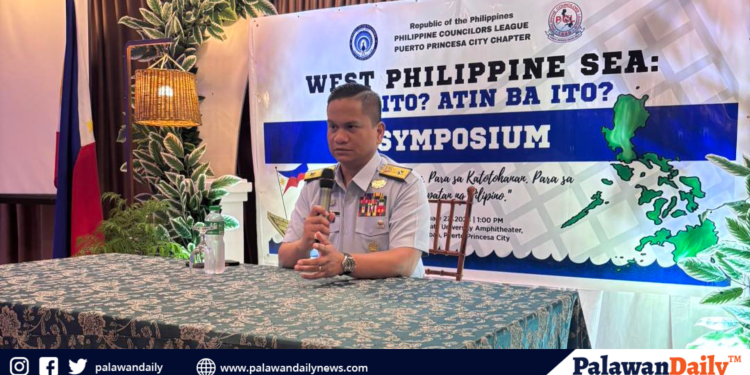
For Commodore Jay Tarriela, the Philippine Coast Guard’s spokesperson on West Philippine Sea issues, the country’s maritime standoff with China is no longer confined to shoals and reefs.
Speaking at a press briefing in Puerto Princesa on Monday, Tarriela said it is unfolding simultaneously in comment sections, algorithm-driven feeds and carefully edited video clips that blur context as effectively as sea spray blurs a lens.
In recent months, Tarriela has spoken with increasing urgency about what he describes as a coordinated effort to distort maritime incidents and soften public resolve. The danger, he argues, is not only external pressure at sea but internal confusion at home.
10 years ago, the Philippines secured a landmark legal victory when the Permanent Court of Arbitration in The Hague invalidated China’s sweeping nine-dash line claim.
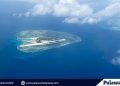
That ruling, though celebrated diplomatically, did not end confrontations on the water. Chinese coast guard and maritime militia vessels continue to shadow and block Philippine ships near Ayungin Shoal, Scarborough Shoal and other contested features within the country’s exclusive economic zone. Each encounter now carries two battles: the physical maneuver and the narrative that follows.
Under President Ferdinand Marcos Jr., the Philippine Coast Guard adopted what officials call assertive transparency.
Instead of downplaying incidents to avoid diplomatic friction, the PCG began releasing near real-time footage of water cannon attacks, dangerous maneuvers and laser-pointing incidents.
The intention was to remove ambiguity. If Filipinos and the international community could see events unfold unfiltered, officials believed it would be harder for false claims to gain traction.
Yet transparency has also triggered a counter-response. Within hours of many incidents, social media posts emerge framing Philippine resupply missions as provocations, questioning the authenticity of footage or suggesting that the country is merely acting as a proxy for larger powers.
Some narratives attempt to recast confrontations as misunderstandings exaggerated for political gain. Others lean into fear, warning that firm maritime enforcement risks dragging the country into war or crippling the economy.
Tarriela has warned advocates and local media that these narratives are not random. In congressional hearings and media briefings, he has described what security experts term foreign information manipulation, a strategy that blends state messaging, online influencers and coordinated amplification to seed doubt.
The goal, he suggests, is not necessarily to convince every Filipino that China’s claims are valid. It is to exhaust the public with competing versions of reality until certainty feels unreachable and indifference becomes the default.
In Palawan, that indifference is not an option. The province sits closest to many of the contested waters. Its fishermen know the cost of a forced detour or an aborted fishing trip.
In towns facing the West Philippine Sea, the sea is not a metaphor but a workplace.
When reports of harassment circulate online, they are measured against lived experience. Still, even here, digital narratives shape perception. A viral video stripped of context can travel farther than a sworn affidavit from a boat captain.
The timing heightens concern. Although the next presidential election remains two years away, political alignments are already forming.
“A politician becoming very soft regarding the issues in the WPS is likely agreeing to his oppressors as well,” Tarriela said.
Maritime policy, once treated as a technical foreign affairs issue, is increasingly woven into domestic political debate. Some aspirants position themselves as pragmatic dealmakers who would ease tensions through accommodation. Others frame resistance as non-negotiable. In this environment, the information ecosystem becomes a strategic arena.
If public opinion can be nudged toward resignation or fear, future policy may follow.
Tarriela has been careful to stress that the Coast Guard is a non-partisan institution. Its mandate is maritime safety and law enforcement, not electoral campaigning.
But he has also drawn a direct line between informed citizenship and national security. A democracy, he often implies, cannot defend its waters if its voters are persuaded that those waters are not worth defending.
The risk is subtle. Disinformation rarely announces itself as such. It often begins with a plausible question, a clipped video, a suggestive caption. It thrives on repetition and the credibility of familiar faces. Over time, it reframes aggression as routine, defense as escalation, and legal victories as empty symbolism. When that reframing takes hold, the consequences are measured not in trending topics but in policy shifts and diplomatic posture.
There is also a psychological toll. Constant exposure to conflicting claims can produce fatigue.
Citizens begin to tune out maritime updates, perceiving them as distant squabbles among politicians and generals.
That fatigue is fertile ground for what some analysts call societal acceptance, the quiet normalization of contested control. A reef lost in practice, if not on paper, becomes yesterday’s headline.
Against this backdrop, the Coast Guard has moved toward what communications experts describe as “prebunking.”
Rather than merely debunking false claims after they spread, officials attempt to anticipate likely distortions and provide context in advance. Detailed timelines, raw video releases and open briefings are meant to inoculate the public against manipulation. It is an experiment in democratic resilience, built on the premise that sunlight can be a strategic asset.
Still, transparency alone cannot guarantee clarity. The information space is crowded and competitive. Algorithms reward outrage and novelty more than nuance. Foreign actors have studied these dynamics for years, testing which messages travel and which fall flat. The Philippines, with its high social media penetration and history of online political mobilization, is fertile terrain.
What happens next may depend less on the next water cannon blast than on the next share button. The maritime dispute will continue to unfold in steel hulls and diplomatic notes. But it will also unfold in group chats, livestreams and campaign speeches. The question is whether Filipinos will approach that digital battlefield with the same vigilance demanded at sea.
In this province, which stands as the country’s nearest gateway to the West Philippine Sea, the stakes are immediate. Energy exploration prospects, fisheries, tourism routes and ecological preservation are tied to stable and sovereign waters. For the nation, the stakes are broader. Sovereignty is not only enforced by ships; it is sustained by a public that understands and values it.
The West Philippine Sea is becoming more than a foreign policy issue. It is a test of whether truth can hold its ground. In this contest, the most decisive force may not be a patrol vessel cutting through waves, but a citizen determined to sift fact from fabrication before casting a vote.