

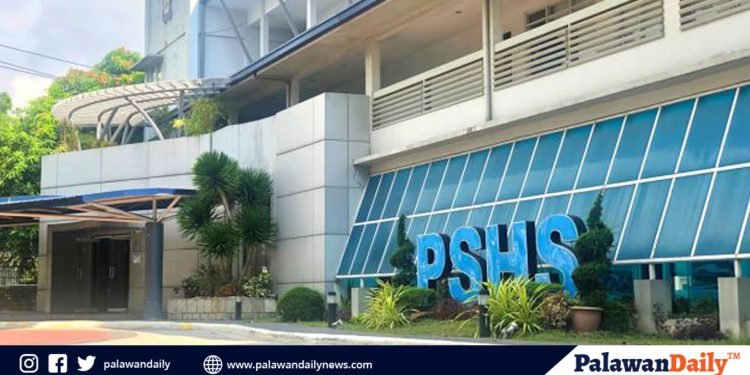

The Department of Science and Technology-Philippines Science High School (DOST-PSHS) System has been pushing for the Expanded PSHS System Act in an effort to reach more students and increase the number of their campuses into two per region, an official said recently.
The initiative aims to provide more opportunities for talented students to pursue science, technology, engineering, and mathematics (STEM) education, which is crucial for national development.
Dr. Sheena Faith M. Ganela, Deputy Executive Director of the DOST PSHS, said that they are hoping that they could open a second Mimaropa regional campus (MRC) in Palawan in addition to the one located in Odiongan, Romblon.
She said that this is possible with the presence of some generous locals who would donate a parcel of land as a school site.
“Siguro mga 7 to 10 hectares ay pwede nang e-host ang pangalawang PSHS dito sa Palawan,” she said.
At present, only 12 students from Palawan are enrolled in PSHS MRC in Odiongan, Romblon. The campus, although located within the Mimaropa region, is not easily accessible to students coming from Palawan considering that they need to travel to Metro Manila first before reaching the province of Romblon.
As of June 10, 2025, both the House of Representatives and the Senate ratified the final version of the Expanded Philippine Science High School (PSHS) System Act, a major milestone in STEM education reform in the country.
With this formal ratification, the bill is now ready for transmittal to the Office of the President, Ferdinand R. Marcos Jr. for his signature.
The proposed law seeks to expand the reach and impact of the PSHS System, the country’s premier science high school network under the DOST. This includes the establishment of more campuses and strengthening institutional capacity to accommodate more students.
The Expanded PSHS System Act would allow for more campuses to be established, with the goal of having at least two campuses per region, excluding Metro Manila.
The expansion intends to address the increasing number of qualified students who are turned down from the PSHS System due to limited space and seeks to create a more inclusive and accessible PSHS System, ensuring that more deserving students will be accommodated and have the opportunity to excel in STEM fields.
In a statement, Secretary Renato U. Solidum Jr. said that “bringing quality STEM education closer to our youth is an investment in a future where every Filipino can help build a stronger, more inclusive nation through science and technology. In this vision of growth, no effort or investment is ever wasted.”
The DOST–PSHS System and its stakeholders eagerly await the bill’s final approval, as it promises to bring more inclusive and accessible STEM education to Filipino youth across the country.