

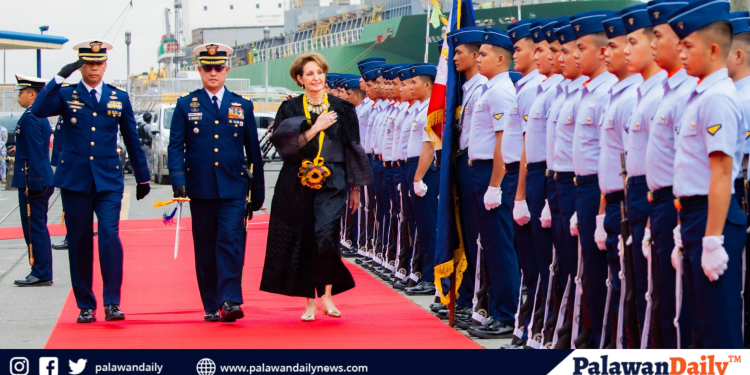

As U.S. Ambassador MaryKay Loss Carlson prepares to leave her post in Manila, she does so at a moment when Philippine–United States relations are arguably at their most active in decades, marked by intensified defense cooperation, rising economic engagement, and renewed people-to-people ties.
Carlson, who assumed her role in mid-2022, formally marked the end of her tenure this week with a farewell statement reflecting on her diplomatic service and the trajectory of bilateral relations. Her departure comes ahead of a milestone year in 2026, when both countries commemorate 80 years of diplomatic relations and the 75th anniversary of the Mutual Defense Treaty.
During her three-and-a-half-year posting, the U.S. and the Philippines deepened cooperation across security, trade, health, and infrastructure, amid growing geopolitical tensions in the Indo-Pacific and renewed emphasis on alliance-building.
Security cooperation figured prominently throughout Carlson’s tenure as Manila pushed forward defense modernization efforts while Washington reinforced its regional strategy anchored on alliances Joint military activities reached record levels with large scale exercises and engagements conducted annually.
The Balikatan exercises grew in size and scope incorporating not only combat readiness but also humanitarian assistance disaster response and maritime coordination functions considered essential for an archipelagic country like the Philippines.
The creation of Task Force Philippines further strengthened coordination on archipelagic defense and disaster response enabling closer operational planning between the two militaries The United States also increased assistance to enhance the capabilities of the Armed Forces of the Philippines and the Philippine Coast Guard particularly in the area of maritime security.
These developments unfolded alongside continuing tensions in the West Philippine Sea where U.S. officials repeatedly affirmed support for the Philippines’ rights under international law and the principle of freedom of navigation.
Economic and trade engagement likewise intensified during Carlson’s term with a series of trade missions and business engagements aimed at expanding American investment in the Philippines particularly in infrastructure energy and emerging industries.
Among the key initiatives launched was the Luzon Economic Corridor a collaborative effort involving the Philippines the United States and Japan designed to accelerate infrastructure development improve connectivity and support long term economic growth.
Washington also scaled up development assistance committing hundreds of millions of dollars to health programs food security energy resilience and efforts to curb illegal fishing an issue with direct implications for coastal and island provinces including Palawan.
Beyond policy and security Carlson repeatedly underscored the role of cultural exchange and community level engagement in sustaining bilateral ties Peace Corps volunteers continued to serve in communities nationwide while long standing academic and professional exchange programs including the Fulbright Commission supported cooperation in education research and governance.
As she prepares to leave Carlson expressed confidence that embassy teams and bilateral partners will sustain the momentum built during her tenure She said she would continue to support U.S. Philippines relations even beyond her official role.
Her departure marks a transition rather than a pause With major anniversaries approaching and regional security dynamics continuing to evolve close coordination between Manila and Washington is expected to remain a defining feature of the alliance in the years ahead.
For provinces such as Palawan which sit at the forefront of maritime security and disaster response the implications of this deepened partnership are likely to remain significant long after Carlson’s tenure ends.