


But unlike in cities where funeral parlors line highways and embalming services are a phone call away, families in this remote town navigate grief without the comfort of such conveniences.
Here, when someone passes away, whether in the coastal barangays or the mountainous sitios, the first call is not to a funeral home, but to the local government unit (LGU).
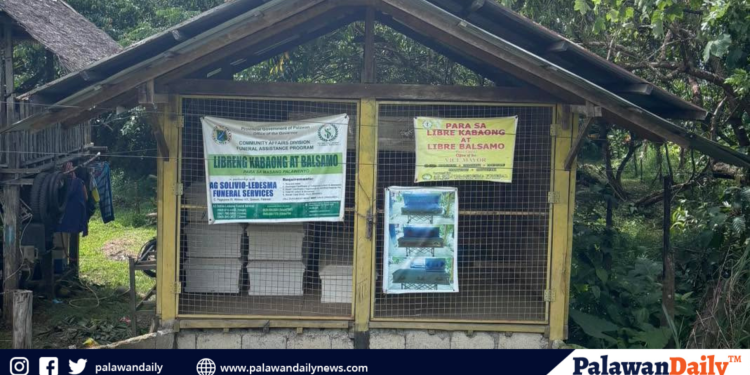
In Barangay Punta-Baja, this small structure sits quietly on the roadside of Purok Liwayway. It resembles a chicken coop at first glance, wood-framed, mesh-covered, and modestly built, but a closer look reveals something more solemn: a stockpile of white wooden caskets, neatly stacked and protected from the elements.
Above them hang tarpaulins printed with messages like “Libreng Kabaong at Balsamo”—Free Coffin and Embalming. It is not just a storage shed. It is a community lifeline.
Through a partnership with a local provider, AG Soldivo-Ledesma Funeral Services, the municipal government arranges for embalming, often dispatching workers to perform the procedure in the deceased’s home or barangay hall.
Transporting the coffin to the deceased’s home is another hurdle. If vehicles can no longer reach the site, volunteers or family members carry it by hand, trekking over hills, crossing rivers, and maneuvering narrow trails for hours.
Rizal’s residents are not homogenous in their ways of mourning. The town’s religious landscape is a tapestry of Roman Catholic, Protestant, Muslim, and indigenous animist beliefs.
According to the Philippine Statistics Authority, over 69% of Palaweños identify as Roman Catholic. In Rizal, this percentage is bolstered by years of missionary presence, though Muslim communities also live in several barangays.
However, in the uplands, among the Palaw’an tribes, traditional beliefs still shape death practices.
Ceremonial rites such as “basal,” a ritual involving music and offerings to spirits, are held to help the dead journey into the afterlife. Some families blend Christian rites with tribal customs, creating uniquely syncretic funerals.
In these cases, the LGU-provided coffins become more than just government assistance, they are the vessels through which ancestral traditions continue, even in the face of poverty and logistical barriers.
This small roadside coffin shed in Punta-Baja may not inspire awe. It doesn’t resemble the solemn marble halls of city funeral homes in cities or other towns, nor does it offer air-conditioned chapels or glossy urn displays. But it reflects something profound — a community that has learned to grieve with dignity, even in scarcity.
For now, the LGU’s modest program stands as a stopgap, a human effort to honor life at its end.