


The Philippines rejected on Thursday China’s latest remarks claiming sovereignty over Pag-asa Island and its surrounding waters, reaffirming that the Kalayaan Island Group (KIG) is an “integral part” of the nation and that it will continue its operations there, regardless of foreign objections.
In a strongly worded statement issued by Department of Foreign Affairs (DFA) spokesperson Ma. Teresita Daza, the Philippines rebuffed the Chinese Embassy in Manila’s assertion of “indisputable sovereignty” over features within the Spratly Islands—an area long disputed and central to ongoing maritime tensions.
“The Department of Foreign Affairs rejects and refutes the recent statements of the spokesperson of the Chinese Embassy in Manila regarding Pag-asa Island and the Pag-asa Cays, and the activities of Philippine authorities in the area,” the DFA said.
The DFA emphasized that “KIG is an integral part of the Philippines over which it has longstanding sovereignty and jurisdiction,” and reiterated that Manila is acting fully within its rights under international law.
“The Philippines is clearly within its rights to conduct routine maritime operations and scientific research in and around these features, and will continue to do so,” the statement read. “China has no right to object much less interfere with these lawful and routine activities.”
The DFA’s statement follows claims made earlier this week by the Chinese Embassy, which accused the Philippines of making “27 unauthorized landings involving 167 personnel on uninhabited features” in the South China Sea. China also dismissed the Philippines’ ongoing marine scientific research efforts as nothing more than “film production rather than genuine research.”
“The underlying intentions behind such activities are self-evident. It is clear which party initiated the provocation and which is engaging in deception,” the Chinese Embassy said.
Beijing further asserted that it will “continue to take resolute measures to safeguard its territorial sovereignty” and preserve the unoccupied status of what it calls Tiexian Jiao—a name it uses for features within what the Philippines identifies as its exclusive economic zone (EEZ).
In response, the DFA stood firm: “The Philippines’ activities in the area are a valid exercise of Philippine sovereignty and consistent with international law,” citing specifically the 1982 United Nations Convention on the Law of the Sea (UNCLOS), the 2016 South China Sea Arbitral Award, and the 2002 Declaration on the Conduct of Parties in the South China Sea (DOC).
“We urge China to respect the Philippines’ sovereignty and jurisdiction, even as we continue to pursue peaceful and legal means to manage differences and the situation at sea,” the DFA said.
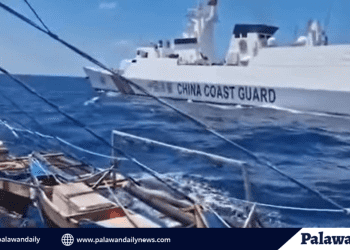
The renewed diplomatic tension follows an incident last week where two civilian Philippine vessels conducting research near Sandy Cay, just four nautical miles from Pag-asa Island, were allegedly harassed by the China Coast Guard (CCG).
The Bureau of Fisheries and Aquatic Resources (BFAR) confirmed that the BRP Datu Sanday was water-cannoned and rammed, sustaining damage to its bow and chimney. The second vessel, BRP Datu Pagbuaya, was shadowed throughout the incident. Both ships were in the area to support scientific missions, the DFA had said earlier.
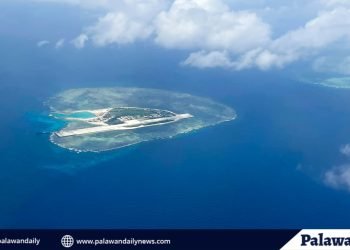
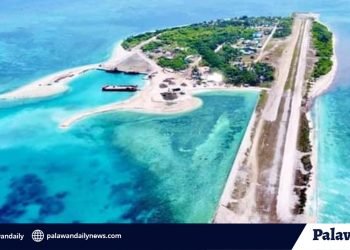
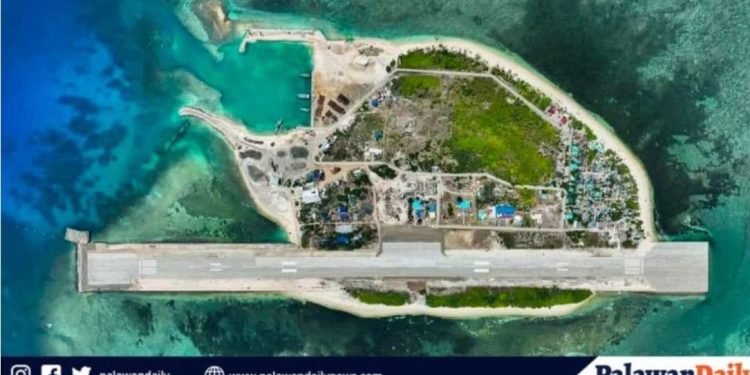
Pag-asa Island—home to a small Philippine civilian population and military detachment—remains a strategic flashpoint in the ongoing dispute over the South China Sea. The island sits within the country’s EEZ and is part of the municipality of Kalayaan, Palawan.
While Manila insists its presence in the area is lawful and anchored in international law, China continues to view Philippine activity near features it claims as violations of prior diplomatic understandings.
The diplomatic tit-for-tat over Pag-asa reflects a broader struggle over maritime control in the South China Sea, where overlapping claims, escalating patrols, and increasingly confrontational encounters have made the region one of Asia’s most volatile flashpoints.
As Manila pushes back against what it sees as “illegal and coercive” actions from Beijing, the language coming from the DFA is notably more assertive. With the 2016 arbitral ruling largely unenforced and the DOC widely seen as aspirational rather than binding, the Philippines’ best defense may be its voice on the global stage—and the legal clarity it holds.