


Every move you make in this city is starting to feel like a luxury. Usually, if you stand on the corner of Jollibee Rizal Avenue during the morning rush hour, the air is a thick, humid soup of diesel fumes, the rhythmic bark of multicab conductors, and the persistent whine of tricycles. It is the chaotic, beautiful soundtrack of our lives.
But today, that music hasn’t just stopped, it has been strangled by the math of an impossible economy.
Across Puerto Princesa, the brightly painted cabs, those “Kings of the Road” that carried us to school, to the market, and to our first jobs, are parked in long, silent rows. Their drivers aren’t taking a siesta, they are in mourning for a livelihood that no longer makes sense.
With the declaration of a National Energy Emergency following the escalation of the war in the Persian Gulf, Palawan, the “Philippine’s Last Frontier,” now finds itself at the very front of a global economic collapse.
𝐓𝐇𝐄 𝐌𝐀𝐓𝐇 𝐎𝐅 𝐀 𝐁𝐑𝐎𝐊𝐄𝐍 𝐋𝐈𝐅𝐄
In Puerto Princesa, we don’t have the luxury of viewing this as a “global shift.” For us, the war is found at the gas station, where the price of a liter is now the metric by which we decide if our children eat or if they walk.
As of April 10, 2026, the arithmetic of survival has turned cruel. Diesel prices at our local pumps have shattered every known record, peaking at an agonizing 153 pesos per liter. For the parents currently counting coins on their kitchen tables, the math has become a ghost story. Before this conflict began, that same liter cost a mere 72 pesos; now, we are paying for a war we didn’t start with money we don’t have.
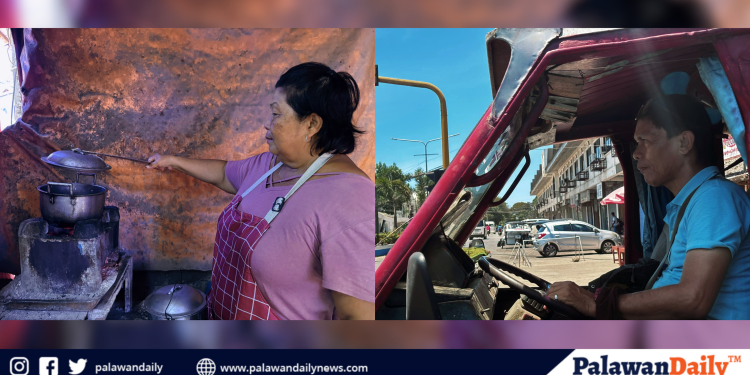
“I look at the meter at the gas station and I want to cry,” says Mang Eddie, 53, a man whose hands are permanently stained with the grease of fifteen years behind a steering wheel. “I used to take home enough to buy a bucket of Jollibee for my kids on Sundays. Now, after 11 hours on the road, I can barely afford the rice to go with a few cans of sardines.”
Eddie represents a demographic of thousands that stretches far beyond our city limits. From the tricycle drivers of Brooke’s Point to the van operators navigating the long haul to El Nido, the province’s drivers are grappling with a brutal ultimatum: drive at a loss or stay home and wait for hunger to arrive.
The paralysis isn’t a theory; it is already creeping across our island. In the terminal hubs of Irawan, the unthinkable has become a daily routine.
A handful of drivers haven’t just slowed down; they have surrendered, choosing to let their engines go cold rather than pay for the privilege of working for nothing. They are hauling their business back home, leaving the very vehicles that once powered our economy to sit as hollowed-out monuments of a failed system.
𝐓𝐇𝐄 𝐄𝐑𝐎𝐒𝐈𝐎𝐍 𝐎𝐅 𝐓𝐇𝐄 𝐏𝐄𝐒𝐎
This struggle is sharpened by a currency that is losing its pulse. According to data from the Philippine Statistics Authority (PSA), as of March 2026, the purchasing power of the Philippine peso has plummeted to approximately 75 centavos compared to 2018 levels. In the markets of Puerto Princesa, this means a 1,000-peso bill, once the bedrock of a weekly grocery run, now carries the weight of only 750 pesos. We are being hit by a double-edged sword: fuel we cannot afford and a currency that can no longer buy the alternatives.
The crisis has breached the sanctity of our homes. In the tight-knit settlements of Barangay Bagong Sikat and the salt-sprayed slums by the pier, the blue flame of the LPG stove has vanished like a ghost. Modernity has become too expensive to sustain, leaving behind cold burners and a growing sense of desperation. LPG has climbed to almost 1,700 pesos per tank, a figure that has quietly redrawn the boundaries of how families cook and eat.
For Loida, a 53-year-old mother of four, the adjustment has already begun. Cooking is no longer routine but calculation. She measures each use of gas with restraint, reserving it for meals that require speed, while turning instead to charcoal for everyday cooking.
“We are already rationing everything,” she said. “I save the gas for quick meals, and cook the rest over charcoal. If it goes higher, there will be nothing left to ration.”
Loida is clear about the threshold that would force a more permanent shift. If LPG prices breach 2,000 pesos per tank, she says, the household will no longer be able to justify its use.
“At that point, we stop using gas completely,” she said. “We will have no choice but to cook outside.”
It is a shift that has already taken hold in parts of her community, where some families have moved their cooking outdoors, relying on wood and ash in place of modern fuel. What was once considered a fallback is now becoming a default.
The “National Energy Emergency” isn’t just a policy in a Manila office; it is now the smell of woodsmoke in a modern city. It’s the rationing of electricity, where families sit in the sweltering April heat with only a single electric fan running, terrified of the next bill from PALECO.
The declaration became official on March 24, 2026, when President Marcos signed Executive Order No. 110. This move followed the closure of the Strait of Hormuz, which strangled the global oil supply and left the Philippines, an nation that imports 98% of its oil from the Middle East, staring into a void. With this executive order, the Philippines became the first country in the world (and naturally the first in Southeast Asia) to formally declare a national energy emergency in response to the 2026 conflict in Iran.
While our neighbors like Vietnam and Indonesia have since implemented their own conservation mandates, we were the ones who first put a name to the nightmare. We didn’t just join the crisis, we headlined it.
𝐓𝐇𝐄 𝐅𝐑𝐀𝐆𝐈𝐋𝐈𝐓𝐘 𝐎𝐅 𝐓𝐇𝐄 𝐈𝐒𝐋𝐀𝐍𝐃
Why does the blow land so heavily here? It is because Palawan is a beautiful, isolated outpost at the end of a dangerously long tether. Nearly every drop of fuel that breathes life into our tricycles, our fishing boats, and our power plants must survive a journey across the sea from the Persian Gulf. We are the last to receive and the first to lose.
When a ‘geopolitical choke point’ thousands of miles away is strangled it is our lights that flicker first. Ser Pena Reyes who serves as an economist at Ateneo De Manila University puts it bluntly by stating that this war has laid bare our structural reliance. He notes that we are a country and Palawan is a province that is far too dependent on the whims of others.
This desperation is mandating a total recalibration of our geopolitical stance. President Ferdinand Marcos Jr. has indicated that the administration may pivot toward joint oil and gas exploration with China within the West Philippine Sea. For a province that has functioned as the primary sentinel of these waters, the concept of pragmatic cooperation with Beijing feels like a jagged pill to swallow. Yet the harsh reality of the present is overriding long-held defiance because as one local fisherman remarked, a legal ruling from The Hague is no substitute for a meal on the table.
Patriotism has become a luxury reserved for the comfortable. When the choice is narrowed down to a theoretical maritime boundary or the literal survival of our fishing fleet, the correct answer depends entirely on whether or not you are the one going hungry.
𝐓𝐇𝐄 𝐋𝐎𝐍𝐆 𝐓𝐀𝐈𝐋 𝐎𝐅 𝐓𝐇𝐄 𝐂𝐑𝐈𝐒𝐈𝐒
The “long tail” of this economic shock will linger for months even if the war were to end tomorrow. Economists are already sounding the alarm on stagflation which creates a nightmare scenario where prices remain stratospheric while the job market remains paralyzed. On the streets of Puerto Princesa there is little patience for the grand speeches of world leaders or the calculated maneuvers of Donald Trump because those abstractions offer no relief from the pressing weight of the now.
The aftermath will not involve a sudden return to the status quo but rather a slow and systemic reorganization of regional daily life. Projections indicate a future where the province must transition toward localized self-sufficiency or face the collapse of the logistics chains that previously sustained the “Last Frontier.”
Data suggests a shift in the urban landscape where the frequency of motorized transport decreases and the bright lights of tourist hubs remain dimmed as power cooperatives prioritize critical infrastructure like hospitals over commercial centers. This crisis is leaving a permanent mark on local commerce that could trigger a migration of the workforce from the coastal service sectors back to agricultural production as the regional economy pivots toward essential resources. The existing blueprints for the city were designed during a period of stable fuel costs and fluid transit but the coming months will require a new framework for survival that favors resource resilience and minimizes external dependency.
“I hope we aren’t invisible to them,” Mang Eddie says while looking out over the silent stretch of Rizal Avenue. He shares his hope that the officials making decisions in high-level meetings realize that their abstract discussions of tactical maneuvers and global energy quotas are the deciding factors in whether his children eat three meals a day or go to bed hungry. He notes that for them, it is a matter of geopolitical strategy, but for his family, it is a direct calculation of whether the money for fuel has to be stolen from the budget for a kilo of rice.
For decades, Palawan measured its success by the number of footprints left on its shores by the rest of the world. We sacrificed our self-sufficiency to build a sanctuary for the global traveler, convinced that becoming a “world-class destination” was our path to prosperity. But today, that dream has become our prison. We are forced to ask: How can we still call this a paradise when the very people who guard it can no longer afford to live in it?
In 2026, the “Last Frontier” is being strangled by a global economy that has turned our beauty into a luxury we can’t touch. Our hardest fight is no longer protecting our seas, but surviving a geopolitical machine that has made the cost of basic survival a financial impossibility. As the luxury vans sit empty and the scent of woodsmoke rises from the backyards of shuttered resorts, the mask of the “best island in the world” finally slips.
Our toughest enemy isn’t our isolation or the disputes in the West Philippine Sea. It is the cold indifference of a system that views our home as a playground for the few and our daily struggle as an acceptable loss. We have built a world-class stage, only to realize we are the ones being pushed into the wings, stranded in a paradise where we can no longer afford the price of admission.
While world leaders trade threats over maritime borders, families in Puerto Princesa are trading their stoves for open fires because the cost of fuel has become a barrier to the most fundamental human act: feeding one’s children.