


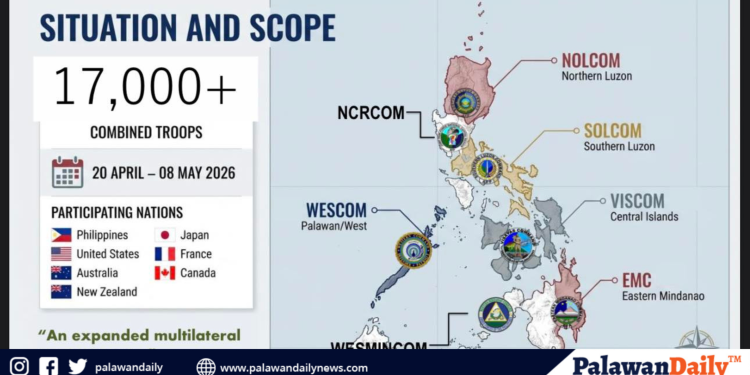

Starting April 20, the 41st iteration of Exercise Balikatan will officially kick off, bringing together more than 17,000 personnel in what officials are calling the most expansive and complex version of the annual drills to date.
For Palawan, the focal point arrives on April 27, when a major “Counter-Landing Live-Fire Exercise” will transform the western shores of Aborlan into a simulated defensive front.
The 2026 exercises mark a significant departure from years past, not just in scale but in the diversity of the “shoulder-to-shoulder” partnership.
Joining the core forces of the Philippines and the United States are troops from Australia, Japan, Canada, France, and New Zealand. Additionally, 17 other nations will observe the maneuvers, signaling a growing international gaze on the security of the West Philippine Sea.
While Aporawan serves as the Western Command’s primary theater, the exercise will pivot north on May 4, with a second live-fire event scheduled for the La Paz Sand Dunes in Ilocos Norte.
This year’s Balikatan is not restricted to traditional beach landings. The scope has widened to include cyber defense, space-related operations, and integrated air and missile defense drills in Subic, Zambales.
Of particular note is the heightened role of the Japan Self-Defense Forces. Moving beyond their previous status as observers, Japanese units are expected to deploy Type 88 surface-to-ship missiles during live-fire strikes, marking a historic level of integration between the three nations.
The drills also coincide with the 75th anniversary of the U.S.-Philippine Mutual Defense Treaty, a milestone military leaders say is “ironclad.”