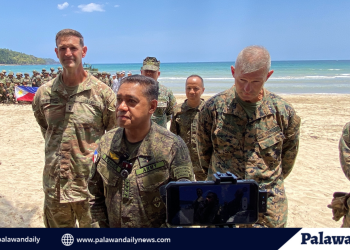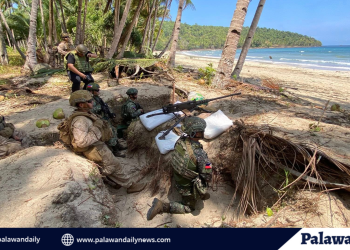


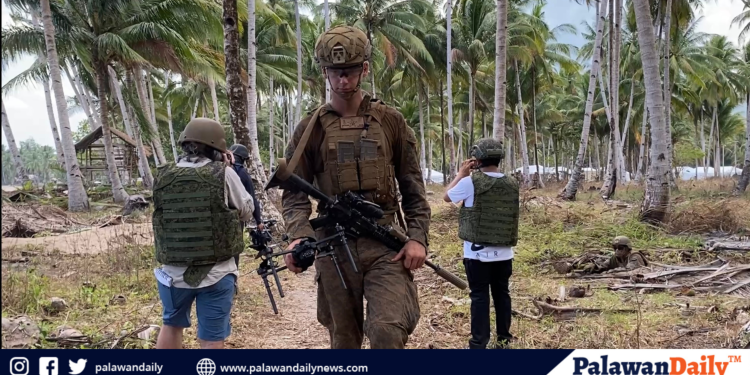

The Armed Forces of the Philippines (AFP) said one of the highlights of the Counter-Landing Live-Fire exercise in Barangay Apurawan, Aborlan on April 27, as part of Exercise Balikatan 41-2026, was the use of unmanned aerial, surface, and ground systems to demonstrate modern combat capabilities.
AFP Chief of Staff Gen. Romeo Brawner Jr. said the use of unmanned aerial vehicles (UAVs) and unmanned surface vehicles (USVs) during the exercise reflects efforts to modernize combat operations and adapt to evolving warfare trends observed in other countries.
“This time, if you noticed, we used unmanned systems very heavily. Unlike in the previous Balikatan exercises, this time we had drones; aerial drones, surface drones that were used heavily in the exercise. We had counter-drone operations as well, because as we see the character of the war around the world is changing and we see the involvement of unmanned systems more and more in the modern warfare,” Brawner said.
The use of drones in conflicts such as the Russia-Ukraine war has demonstrated advantages including real-time intelligence and surveillance, disruption of enemy logistics, and precision strikes, enhancing overall combat effectiveness.
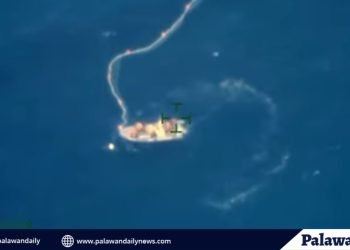
During the exercise, one surface drone was destroyed. However, Brawner clarified that this was part of the scenario.
“It was part of the scene, we did not target all the surface vessels. We targeted some of them but if you saw how accurate our fires were against surface vessels, against unmanned surface vessels even against drones no matter how small they are, with our modern weapon system and our great collaboration and cooperation among all the armeo forces we were able to hit the target accurately,” he said.
Philippine forces deployed FA-50 fighter jets for air interdiction, 105 mm howitzers, and light armored vehicles (LAVs), while United States forces utilized the High Mobility Artillery Rocket System (HIMARS). Troops fired live rounds to defend a coastal area during a simulated territorial invasion.