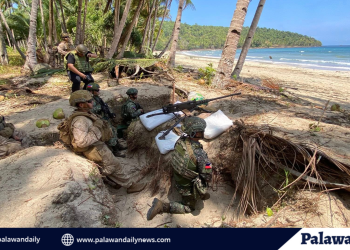


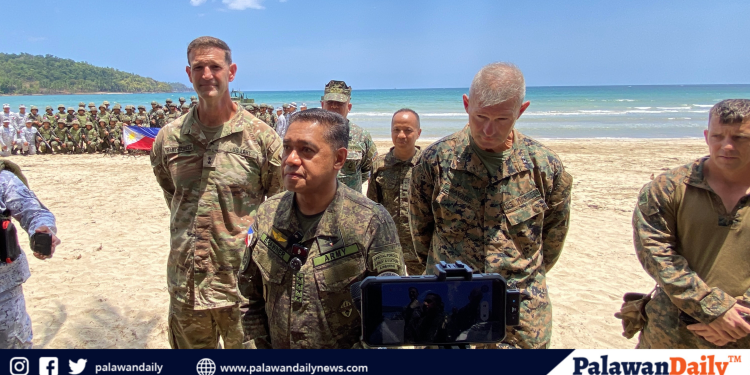

The coastal village of Aporawan became the stage for the largest live fire demonstration yet under Exercise Balikatan, as more than 500 service members from the Philippines, United States, Australia, and New Zealand moved as one force along the shoreline.
In Aborlan, the exercise unfolded as a simulated defense against a maritime invasion. Troops worked through a coordinated response that began with detection and ended before any simulated enemy could reach land.
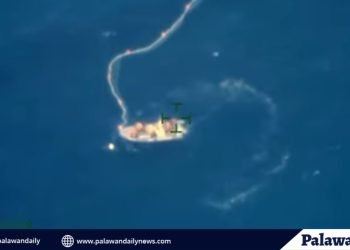
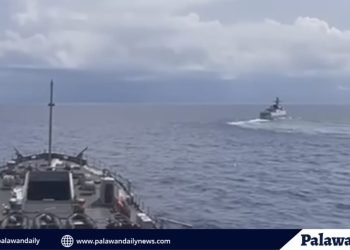
High Mobility Artillery Rocket Systems, Javelin anti armor missiles, and fighter aircraft were deployed to strike a notional enemy vessel and amphibious assault boats approaching the coast. The targets were neutralized offshore.
In a five minute briefing that followed, Gen. Romeo Brawner Jr. emphasized the scale of the operation.
“This is by far the most expansive iteration of Balikatan,” Brawner said, noting that the exercise now includes seven participating nations.
The training centered on multi domain operations, where surveillance and intelligence systems transmitted real time data into a shared command node. This allowed forces from four countries to coordinate actions across land, sea, and air at the same time.
Philippine Marine Col. Dennis Hernandez described the level of coordination as necessary for protecting “territorial integrity with precision, speed, and overwhelming coordination.”
When asked if the display of capability was intended to send a message to Xi Jinping, U.S. Marine Maj. Gen. Thomas Savage declined to address the question directly. He instead affirmed that “the commitment of the U.S. to the Philippines is solid.”
The exercise also marked the first participation of New Zealand’s 2nd 1st Battalion, Royal New Zealand Infantry Regiment in a Balikatan live fire drill.
U.S. Marine Corps Col. G. J. Flynn III said that while equipment and systems are critical, the core of the exercise remains human connection.
“The friendships made being in the dirt in defensive positions alongside each other,” he said, are central to the training.
“We can talk about all the capabilities we have, but the integration of those capabilities is the cornerstone of how this is done right,” he added.
As the exercise reached its peak, a unified defensive line composed of forces from all participating nations delivered a final coordinated barrage on remaining targets. The simulated threat was neutralized and the beachhead secured.
New Zealand Army Capt. Will Hutchinson said their involvement focused on strengthening cooperation with partner nations.
He described the effort as part of deepening “interoperability with partner nations and our ally, Australia,” adding that it is a partnership they “are looking to continue in the future.”